R&D · AI-assisted symbol research
Research & development
Build a hexadecimal visual encoding library that turns a large identifier, such as a wallet address, into a human-friendly picture.
The ShapeAddress encoder should make identifiers distinguishable, memorable and simple to compare and match. The representation should be easy to transmit over a voice channel and allow quick recovery of the original input string.
The Picto-Art “Colorful Symbols” output uses a target palette of 6–8 basic colours and a set of pictograms selected for recognition across cultures, such as triangles, squares, circles, stars and hearts.
- 128-symbol catalogue
- Selection criteria
- Research workflow
- Evidence and tools
- Use cases
- A. Symbols (glyphs)
- Recognizability
- Familiarity
- Naming
- Variations
Use cases
- Crypto wallet address placeholder.
- Account identicon placeholder.
- User avatar for individual wallets or subprojects.
A. Symbols (glyphs)
Find widely known symbols for a worldwide audience, especially global internet users. Start with simple geometric forms and familiar pictograms. Assemble a candidate list of at least 100 unique symbol concepts, then assess them using the five selection criteria below.
Drawing variations do not count as additional unique symbols. Keep a base symbol and its variations together so the study can compare different drawings of the same concept.
Current phase: research with the assistant and sub-agents, using existing evidence, SVG rendering and AI review. The catalogue currently contains recognition and familiarity estimates, computed name-length scores and raster neighbors. Per-symbol AI pairwise and memorability ratings are the next assessments.
1. Recognizability, including rendering robustness
Highest priority. Recognizability asks whether the symbol can be identified. Rendering robustness asks how well the drawing preserves its identifying features as size and rendering conditions change. Keep both within this category, with their observations recorded separately.
Compare small sizes, thin strokes, internal gaps, contrast, backgrounds, pixel density, scaling and compression. Record the glyph canvas and actual ink size separately from the size of a complete address image.
| Size measure | What to record |
|---|---|
| Ideal | The tested size at which identifying features remain clear and the evaluated drawing is easy to identify. |
| Hard | The tested sizes at which details degrade, identification becomes uncertain or a similar glyph becomes plausible. |
| Smallest identified | The smallest tested size at which the evaluated drawing is still correctly identified in the recorded task. |
| Not identified | The tested sizes at which identifying features are lost or the AI evaluator cannot identify the drawing. |
For AI visual evaluations, record the model, task, source drawing, pixel size, rendering conditions and actual answers. Label the resulting size bands as AI evaluation results. Current R scores are preliminary judgments; the full robustness benchmark has not yet been run.
2. Familiarity
Research how broadly known the shape, object or sign is. Simple forms, familiar physical objects, widespread use and long history are useful evidence to investigate. Familiarity stays separate from how this particular drawing survives at small sizes.
Record a relevant cultural or regional interpretation as a minor note, rather than a separate primary score.
3. Short naming for voice
Use the shortest name that adequately identifies the glyph. Count the words actually spoken, including a direction when needed. Current names are English; names in other languages can be researched separately.
- One word: ideal, score 5. For example, “square” or “heart”.
- Two words: good, score 4. For example, “right arrow” or “top arrow”.
- Three words: less desirable, score 3. For example, “mortar and pestle”.
- More than three words: bad, score 1. For example, “arrow pointing to right”.
Score 2 is unused in this categorical rule. A hyphen does not shorten spoken phrases: “right-arrow” still has two words. Established one-word names such as “snowflake” count as one. Short aliases such as “cup” and “mug”, or “wrench” and “spanner”, do not reduce the name-length score. Record uncertainty about what a drawing depicts in its notes.
Drawing variations
Each symbol may have multiple drawings. Compare variations within the same symbol concept and keep their recognizability, familiarity and naming results separate.
- Airplane: a horizontal plane facing right or left, an upward-facing plane like the Material flight icon, or a plane angled at 45 degrees. Compare Font Awesome and Material drawings as variations of the same symbol.
- Arrow: thick or thin strokes, with direction recorded for each drawing.
Store the icon source, orientation and stroke weight with each variation so results can be traced to the drawing that was actually tested. Several airplane drawings still count as one base symbol toward the 100-symbol minimum.
Related tools: Lab for inspecting glyphs and layouts at actual pixels, and Dictionaries for the current encoding tables.
Classified symbol catalogue
128 candidate concepts, with drawings, recognition and familiarity estimates, short-name scores and a reason to inspect or redraw each one.
128unique concepts
16categories
136drawings, including variants
3raster sizes checked
How to read the scores. R = preliminary recognizability estimate; F = preliminary familiarity estimate; N = spoken-name length score. Naming follows the one/two/three/more-than-three word rule above. R and F are assistant judgments on a 1–5 scale. Pairwise AI ratings and memorability estimates are pending; pixel overlap is already available as a separate diagnostic.
“Inspect first” means the current R/F/N scores are all at least 4. “Compare” means all are at least 3. Other candidates need redrawing or further review. This initial queue uses those three scores; the final set also needs pairwise and memorability assessment.
Preview sizes are CSS pixels for one square canvas; the longest ink edge occupies about 80% of it. A 16 px canvas therefore has about 12.8 px of glyph ink. Previews use your browser and display density; raster diagnostics record their native pixel size separately.
Loading the catalogue. R/F are estimates; N follows the spoken-word rule.
| Symbol | Class / priority | R est. | F est. | N | Closest ink at 16 px | Review notes / variants |
|---|
No matching concepts. Change the search or filters.
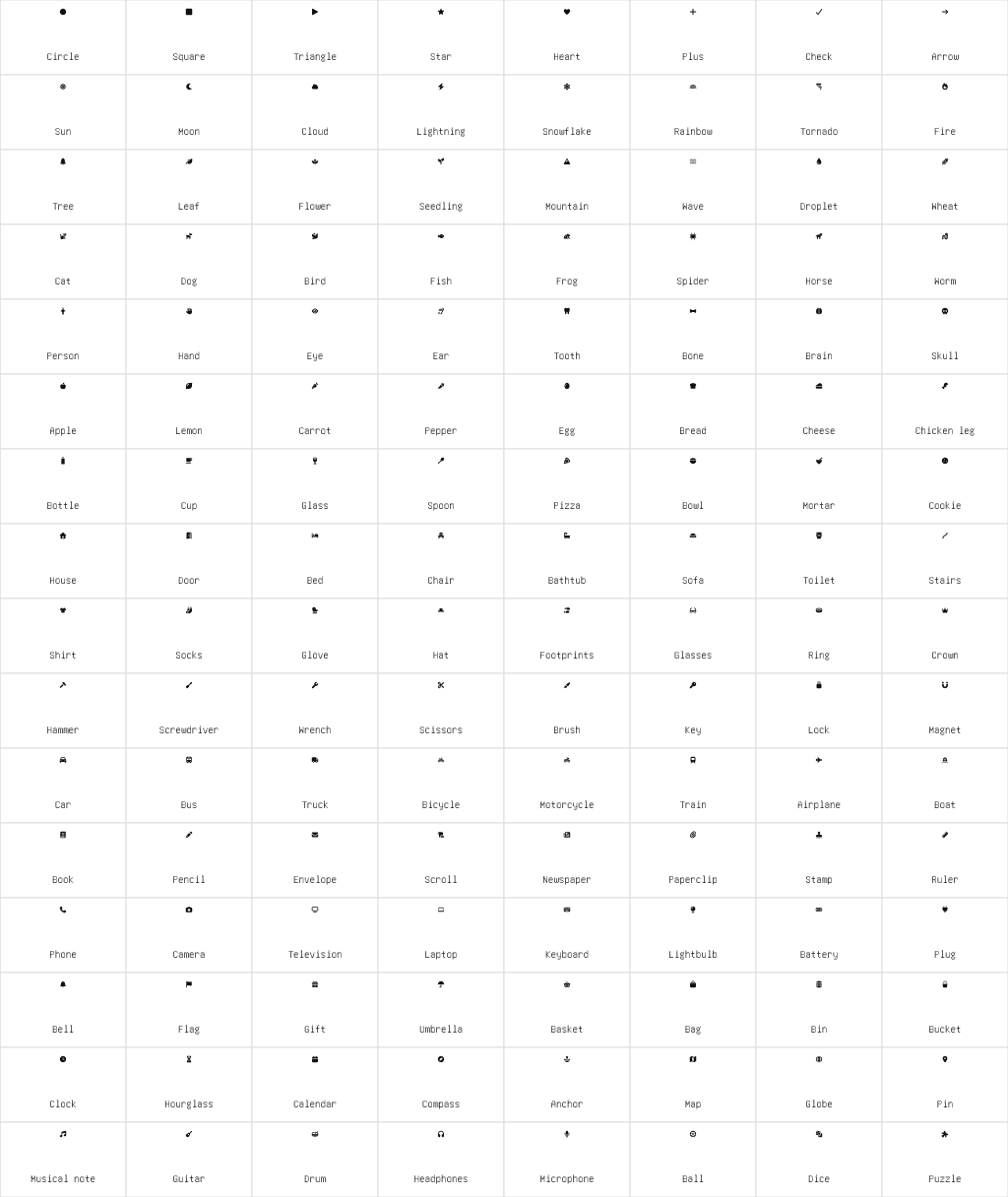
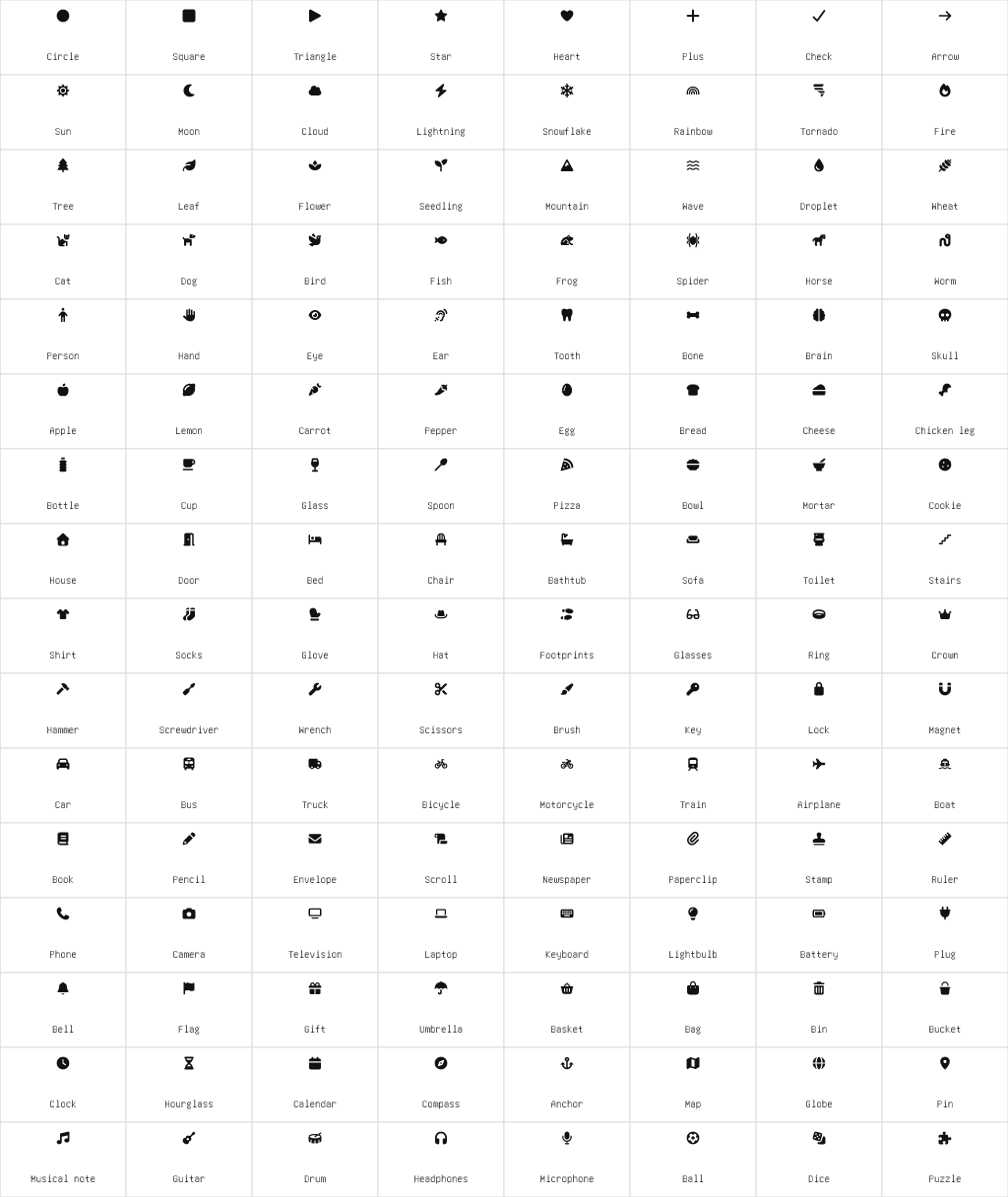
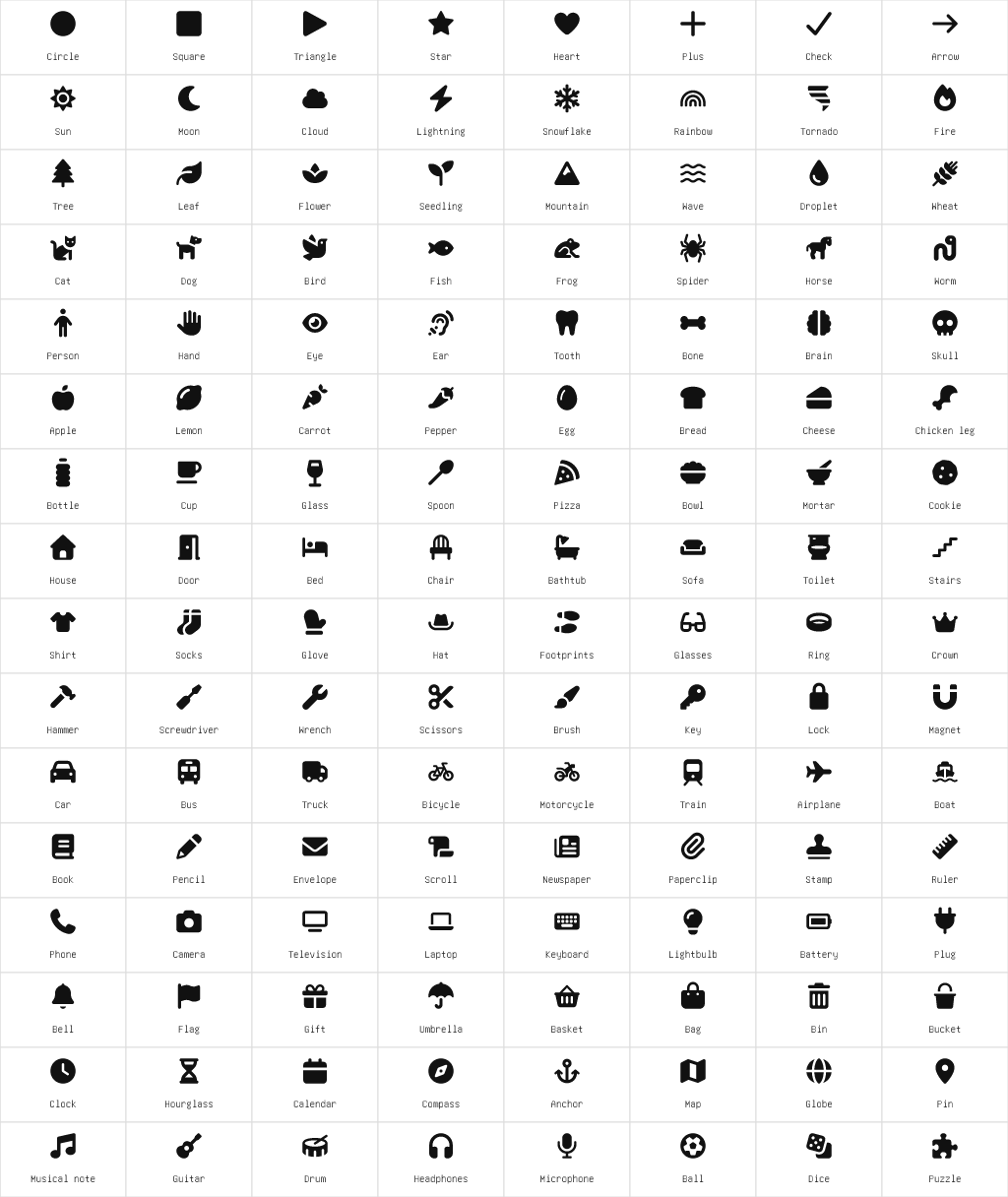
Raster diagnostic: resvg renders each baseline at 8, 16 and 32 pixels. The catalogue shows the most similar of the other 127 baselines by cosine overlap of the alpha masks at 16 px. Alignment, vocabulary and human perception can change which pair is actually confused.
Baseline art: Font Awesome Free Solid 7.3.1, © Fonticons, Inc., CC BY 4.0. Two alternate drawings: Google Material Icons, Apache 2.0. Drawings are normalized and shown in monochrome; source and modifications are recorded per variant. Font Awesome notices · Material license. The art retains its source license.
The five selection criteria
- Recognizability, including rendering robustness: highest priority. Assess identification at small sizes and how well essential features survive changes in contrast, background, pixel density, scaling and compression. Keep the observed identification and rendering diagnostics separate within this one category.
- Pairwise distinguishability. Compare each glyph with the others at the target size. Use raster neighbors to identify likely problem pairs, then use AI visual review of those pairs and the proposed final alphabet.
- Memorability. Estimate how easily the symbol forms a simple, distinctive mental image tied to a name or familiar object. Give a reason and record reviewer disagreement. These are AI judgments; they do not measure a person's recall after a delay.
- Familiarity. Investigate how broadly known the shape or object is. Favor simple forms and familiar pictograms, using existing evidence and usage where available.
- Short naming for voice. One word is ideal, two are good, three are less desirable, and more than three are bad. Record the actual spoken name and its word count, including direction modifiers when needed.
Cultural ambiguity is a minor note when relevant. Source attribution is documented with each drawing, outside the symbol-selection scores. Recognizability has highest priority; a weighted total is not used.
Research with the assistant and sub-agents
The active workflow combines published evidence, reproducible renderings and AI assessment. Two sub-agent reviews have checked this five-category framework and the naming rule. Their advice is reflected here; per-symbol visual and memory evaluations are recorded separately when performed.
- Classify the candidate pool. Keep at least 100 distinct concepts, with orientations, weights and source drawings grouped as variants. Research familiarity and record the shortest adequately identifying name.
- Render the drawings. Use fixed canvas and ink sizes, starting with 6, 8, 10, 12, 16, 20, 24 and 32 px. Compare useful variants, light and dark backgrounds, low contrast, scaling and compression. The current raster diagnostic has run at 8, 16 and 32 px; the broader robustness matrix remains to be run.
- Run AI visual evaluations. Give evaluators unlabeled, randomized images and keep answer keys separate. Record the model, prompt, exact drawing, native pixel size, display transformation and answers. Report clear, degraded and not-identified conditions for the tested model and task.
- Review likely confusion pairs. Compare close raster neighbors and visually similar candidates at the same size. Separate pixel-overlap measurements from AI judgments of distinguishability.
- Estimate memorability. Have sub-agents assess distinctive cues, familiar associations and interference from similar symbols. Keep their reasons and disagreements before reconciling the estimates. Model recall experiments, if used, describe model behavior.
- Compare the candidate alphabet. Review recognizability, pairwise separation, memory cues, familiarity and short names together. Preserve raw results and reasons rather than hiding a weak pair behind an average score.
Evidence labels: distinguish published research, assistant estimates, recorded AI visual evaluations, raster diagnostics and the computed word-count rule. The existing catalogue's R and F are estimates; N is a rule-based score. AI pairwise and memorability scores are currently pending. This phase does not depend on recruiting participants.
Tools: versioned SVGs from Font Awesome and Material, resvg and browser rendering, pixel diagnostics, literature research and AI sub-agents. Assessments describe the drawing and evaluation conditions used; universal human pixel limits are not claimed.
Format context: the current codec uses eight colours × 32 glyphs to cover 256 byte values. The candidate pool supports later dictionary selection; choosing a 16-glyph alphabet would be a separate encoding decision.
Evidence and provenance
Separating familiarity, name agreement and complexity follows Snodgrass and Vanderwart’s picture norms. Those norms are for their original drawings, not these SVGs. Zender and Cassedy’s cross-cultural medical-icon study shows why experience and knowledge need to be investigated alongside culture; it does not establish scores for this catalogue.
The public descriptions of ISO 9186 distinguish comprehension from perceptual identification. They provide background definitions for this AI research; this workflow does not claim ISO-compliant testing.